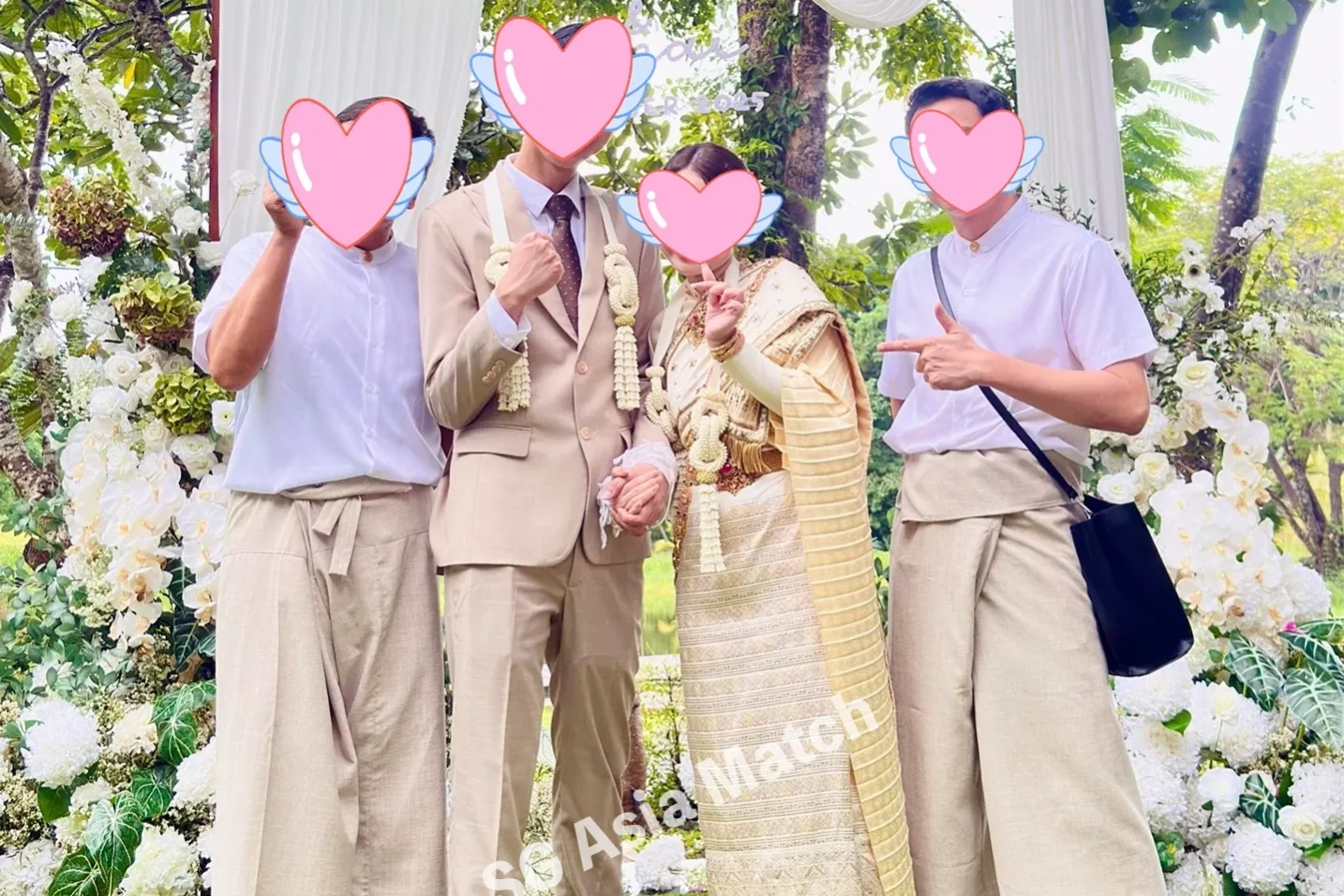
Target URL: /singapore-international-marriage-success-stories/
Focus Keywords: international marriage agency Singapore review, Thai wife Japan spouse visa, Japanese man Thai woman marriage, Singapore foreign wife LTVP
TL;DR – This is a real-style international marriage case based on the kind of cross-border process SG Asia Match has handled for many years: a Japanese professional meets a Thai woman by private ZOOM introduction, travels to Bangkok for in-person matchmaking, registers the marriage legally in Thailand and Japan, applies for her Japanese spouse visa, and finally begins married life together in Japan. For Singaporean men, the relationship-building process is very similar, but the immigration route changes from Japan’s spouse visa process to Singapore’s PMLA and LTVP pathway.
| Stage | Japan + Thailand Case | What Changes for a Singaporean Man |
|---|---|---|
| First introduction | Private ZOOM meeting with a verified Thai profile | Same ZOOM introduction process |
| In-person meeting | Bangkok matchmaking visit and family meeting | Usually Bangkok or Thailand visit as well |
| Marriage registration | Thailand district office, then Japan family register update | Singapore ROM or overseas marriage recognition, depending on plan |
| Immigration | Certificate of Eligibility and Spouse of Japanese National visa | PMLA before marriage, then ICA LTVP after marriage |
| Relocation | Thai wife enters Japan and registers local residence | Thai or Chinese wife relocates to Singapore after LTVP approval |
| Typical planning window | Around 9 to 14 months from first ZOOM to living together | Similar relationship timeline, different government forms |
International marriage is not a fantasy built on one good video call. It is a careful process: verified introductions, real communication, in-person meetings, family understanding, civil registration, immigration paperwork, and the first months of living together in a new country.
For Singapore men considering this path with a Thai partner, pair this case with our Thai marriage guide for Singapore men. For the immigration stage after marriage, see our Singapore LTVP guide for a foreign wife.
SG Asia Match has been working in this field since 1997. Much of our long-term experience has come from introducing Japanese men to Thai women, Japanese men to Chinese women, and serious Asian men to marriage-minded Thai and Chinese women. That background matters because international marriage is rarely just about “meeting someone.” It is about helping two people move from interest to trust, and from trust to a legally secure married life.
The story below is anonymised to protect privacy. Names and minor identifying details have been changed, but the process reflects a realistic international marriage journey that many cross-border couples recognise.
The Couple: Kenji and Arisa
Client: Kenji, 43, Japanese, senior engineer based in Yokohama
Partner: Arisa, 32, Thai, office administrator from Bangkok
First meeting: Private ZOOM introduction
First in-person meeting: Bangkok matchmaking visit
Marriage route: Thailand civil marriage registration, then Japan marriage notification
Visa route: Spouse of Japanese National visa after Certificate of Eligibility
Timeline: Around 12 months from first ZOOM to living together in Japan
Kenji had a stable career, a quiet personality, and very little patience for casual dating. He had tried apps in Japan, but he felt the conversations were often vague. Some people were not ready for marriage. Some were simply browsing. Others disappeared after a few messages.
What he wanted was not complicated: a sincere woman who wanted family life, could adapt to Japan with support, and understood that marriage across countries requires patience from both sides.
Arisa was also serious. She had worked in Bangkok for several years, helped support her parents, and wanted a stable marriage rather than a short-term international romance. She was not looking for a sponsor. She wanted a husband who respected her family, her language, and the practical reality of moving to another country.
That shared seriousness is why the first ZOOM mattered.
Step 1: The First ZOOM Introduction
Before the first meeting, Kenji’s consultant reviewed his expectations carefully: age range, language comfort, family values, willingness to visit Thailand, and whether he was emotionally ready for marriage rather than only “trying something new.”
Arisa’s profile had also been reviewed through SG Asia Match’s direct recruitment and interview process. This is an important difference from dating apps. The women introduced through our service are not random online profiles. They are personally interviewed, screened, and selected for genuine marriage intention.
The first ZOOM call lasted about 70 minutes. Kenji was nervous at the beginning, so the consultant helped set a simple structure:
- Basic personal introductions
- Work and daily life
- Family background
- Marriage expectations
- Future living plan in Japan
- Questions from both sides
The conversation was not dramatic. It was better than dramatic: it was calm, respectful, and real.
Kenji later said the most important moment was when Arisa asked what kind of life he imagined after marriage. She did not ask about luxury. She asked about routine: dinner, work hours, visiting family, language learning, and whether he would help her adjust to Japanese life.
That was when he realised she was thinking like a future wife, not like someone chasing a foreign lifestyle.
Step 2: More ZOOM Calls Before Any Travel
The first call was promising, but neither side rushed. Over the next two months, they had several more ZOOM sessions. Some were arranged formally; others were shorter calls after work.
This stage is where many international relationships either become clearer or quietly end. A beautiful profile is not enough. Both people need to see whether communication can continue after the first excitement fades.
Kenji and Arisa discussed practical topics:
- Whether Arisa was willing to live in Japan long-term
- How often she hoped to visit Thailand after marriage
- Whether Kenji could accept Thai family obligations
- How they would manage language learning
- Whether Arisa wanted to work in Japan in the future
- How Kenji’s parents might react to an international marriage
These conversations made the Bangkok meeting much more productive. By the time Kenji booked his trip, he was not flying to meet a stranger. He was flying to meet someone he already respected.
Step 3: Bangkok Matchmaking Visit
Kenji travelled to Bangkok for a four-day visit. The purpose was not a tourist date. It was a structured in-person meeting with enough time to see whether the connection worked in daily life.
The first meeting was arranged in a comfortable public setting. A consultant helped with the opening and remained available, but the couple were given enough private time to talk naturally.
Over the next few days, they had meals together, visited a shopping area, and spent time discussing family expectations. Kenji also met a relative from Arisa’s side. This was important. In Thai culture, marriage is not only a private decision between two adults; family trust often matters deeply.
Kenji noticed three things in Bangkok:
- Arisa was the same person offline as she had been on ZOOM.
- Her family understood that she might live in Japan after marriage.
- The relationship felt calmer and more practical than his previous dating experiences.
Arisa noticed something too: Kenji did not behave like a tourist shopping for a wife. He was careful, slightly shy, and serious about paperwork, timing, and her future comfort in Japan.
That gave her confidence.
Step 4: Decision, Family Consent, and Document Planning
After Kenji returned to Japan, the couple continued talking for several months. He visited Bangkok again, and this second visit became the point where both sides agreed to move toward marriage.
For an international couple, the decision to marry is also the decision to prepare documents correctly. This is where experienced support becomes valuable. A missed certificate, wrong translation, expired document, or misunderstanding between two government systems can delay the entire plan.
For a Japanese man marrying a Thai woman, the couple usually needs to think about two legal systems:
- Thailand: the legal marriage registration at a district office, often called an Amphur or Khet office
- Japan: the marriage notification so the marriage is reflected in the Japanese family register, or koseki
The exact requirements can vary by district office, city office, embassy, and the couple’s personal history. Divorced applicants, name changes, previous marriages, and document issue dates can all affect the checklist. That is why the couple should confirm details with the relevant office before final submission.
Step 5: Marriage Registration in Thailand
Kenji and Arisa chose to register their marriage first in Thailand. This is a common route when the Thai partner is living in Thailand and the couple wants the Thai marriage certificate before the spouse visa process.
The broad document flow was:
- Kenji prepared proof that he was legally free to marry.
- The document was translated and legalised as required.
- Arisa prepared her Thai ID and family registration documents.
- The couple attended the district office with witnesses.
- The Thai civil marriage was registered.
- The couple received Thai marriage registration documents.
For the foreign partner, Thailand commonly requires a passport and a certificate or affidavit showing legal capacity to marry or single status. For the Thai partner, the usual documents include Thai ID and household registration. Translations and legalisation are a major part of the process, especially when documents move between Japanese, English, and Thai.
The wedding celebration itself can be simple or elaborate, but the legal marriage is created by the civil registration. A private ceremony alone is not enough.
Kenji and Arisa kept the ceremony small. For them, the important point was not a large wedding. It was getting the legal foundation right.
Step 6: Reporting the Marriage to Japan
After the Thai marriage registration, Kenji needed the marriage to be recognised in Japan as well. For Japanese nationals, the marriage must be reflected in the Japanese family register.
In practical terms, this usually means submitting a marriage notification and supporting documents to the proper Japanese authority, either through a municipal office in Japan or through a Japanese embassy or consulate route when overseas.
The package may include items such as:
- Thai marriage certificate or marriage registration record
- Japanese translation of Thai documents
- Kenji’s Japanese family register documents
- Arisa’s identity documents
- Forms required by the Japanese side
Once accepted, the marriage is recorded in the koseki. This is a key step before or during the spouse visa planning because it proves the legal marital relationship under Japan’s family registration system.
This stage is not emotionally exciting, but it is one of the most important stages. A couple can love each other deeply, but immigration officers need documents, dates, translations, and evidence that the marriage is legally valid.
Step 7: Applying for the Japanese Spouse Visa
After the marriage was properly documented, the couple prepared the immigration route for Arisa to live in Japan.
For the wife of a Japanese national, the common route is:
- Apply in Japan for a Certificate of Eligibility, often called a COE.
- After the COE is issued, the Thai spouse applies for the Spouse of Japanese National visa through the Japan visa application route in Thailand.
- Once the visa is issued, she enters Japan.
- After arrival, she completes local residence procedures in Japan.
The spouse visa file is not only about the marriage certificate. It also needs to show that the marriage is genuine and that the couple has a realistic life plan. Evidence may include the couple’s communication history, photos from visits, travel records, family meeting details, the Japanese spouse’s income or tax documents, residence information, and a written explanation of the relationship.
Kenji was an engineer, so his income documents were straightforward. The more important part was proving the relationship history clearly: first ZOOM, later calls, Bangkok visits, family meeting, marriage registration, and the plan for Arisa’s life in Japan.
The visa was approved, and Arisa moved to Japan. The first months were not perfect. She missed Thai food, warm weather, and easy conversations in her own language. Kenji had to learn that “support” did not only mean paying bills. It meant helping her with city office procedures, mobile phone setup, Japanese lessons, and daily confidence.
That is where post-marriage support matters. International marriage does not end at visa approval. In many ways, the real marriage begins after arrival.
What Made This Marriage Work?
Kenji and Arisa’s story worked because the process was serious from the beginning.
They did not rush from one ZOOM call to marriage. They used ZOOM to check values. They used the Bangkok visit to check real chemistry. They used family meetings to build trust. They treated marriage registration and visa preparation as a shared project, not as paperwork left to the last minute.
The strongest international couples usually have five things in common:
- They are honest about where they will live.
- They talk about family obligations early.
- They do not hide financial reality.
- They prepare documents before deadlines become stressful.
- They understand that cultural adjustment continues after the visa is approved.
This is why experienced matchmaking is different from simple introductions. The introduction is only the first door. The real value is helping the couple move through the whole path with fewer surprises.
How Is the Process Different for a Singaporean Man?
For a Singaporean man meeting a Thai or Chinese woman through SG Asia Match, the relationship process is very similar at the beginning:
- Private ZOOM introductions
- Verified profiles
- Consultant-guided matching
- In-person visit to Thailand or China
- Family meeting and marriage planning
- Support with documents and relocation expectations
The main difference is not the romance. The main difference is the government pathway after the couple decides to marry.
1. Singapore Uses PMLA and LTVP, Not Japan’s COE System
Japan commonly uses the Certificate of Eligibility and Spouse of Japanese National visa route. Singapore does not use that system for a Singapore citizen’s foreign wife.
For Singapore, the important route is usually:
- Complete the Pre-Marriage Long-Term Visit Pass Assessment, or PMLA, before marriage.
- Register the marriage legally, either in Singapore or overseas depending on the couple’s plan.
- Apply for the Long-Term Visit Pass, or LTVP, after marriage through ICA, with the Singapore citizen spouse as sponsor.
ICA states that PMLA can give couples greater clarity before marriage. A positive PMLA is not the LTVP itself, but it can shorten the later LTVP processing time. Singapore citizen and non-resident couples who completed PMLA before marriage may receive LTVP processing within about 6 weeks, compared with up to 6 months when PMLA was not submitted.
2. Singapore Does Not Have a Koseki System
Japanese men must think about the family register, or koseki. Singaporean men do not have that step.
Instead, Singaporean couples focus on legal marriage evidence recognised for Singapore purposes, such as a Singapore marriage certificate or an overseas marriage certificate with the necessary translation, authentication, or supporting documents when required.
3. The Sponsor Evidence Is Different
For Japan, the Japanese spouse’s residence, tax, income, family register, and relationship history are central to the spouse visa file.
For Singapore, ICA looks at the couple’s application holistically. Important factors can include the Singapore sponsor’s ability to support the family, the length and genuineness of the marriage, children if any, and whether either person has adverse records.
The principle is similar: the government wants to see a real marriage and a stable life plan. The documents are different.
4. The Wife’s First Months Are Different
A Thai wife moving to Japan must adapt to Japanese language, municipal procedures, residence registration, health insurance, daily transport, and a very different work culture.
A Thai or Chinese wife moving to Singapore faces a different adjustment: English-speaking public systems, HDB or private housing realities, ICA appointments, local employment rules, multicultural family expectations, and life in a compact city-state.
In both cases, the husband must be actively involved. A foreign wife should not be left alone to “figure it out” after arrival.
Why This Story Matters for Singaporean Men Too
Some Singaporean men ask why a Japan-Thailand case is relevant to them.
It is relevant because the hardest part of international marriage is not the name of the visa. The hardest part is building a relationship across language, country, family expectations, and government systems.
SG Asia Match’s long experience with Japanese men marrying Thai and Chinese women gives us practical knowledge that applies strongly to Singaporean clients:
- How to screen for genuine marriage intention
- How to prepare men for the first ZOOM call
- How to arrange serious in-person meetings in Bangkok
- How to discuss family expectations without embarrassment
- How to organise timelines around documents
- How to support the couple after marriage, not only before it
The Singapore route has its own forms and timing, but the human process is familiar: verified introduction, careful relationship building, proper registration, spouse immigration, and real integration after relocation.
A Practical Timeline From First ZOOM to Living Together
Here is a realistic timeline for a serious cross-border marriage case.
| Month | Main Action |
|---|---|
| Month 1 | Free ZOOM trial and first introductions |
| Months 1-3 | Regular ZOOM calls, consultant feedback, compatibility check |
| Months 3-5 | Bangkok visit, in-person meeting, possible family introduction |
| Months 5-8 | Continued relationship, second visit, marriage decision |
| Months 8-10 | Document preparation and civil marriage registration |
| Months 10-12 | Spouse visa or LTVP application, depending on destination country |
| Months 12-14 | Visa/pass approval, relocation, first-stage settlement support |
Some couples move faster. Some need more time. The best timeline is not the shortest timeline. It is the timeline that gives both people enough confidence to build a stable marriage.
What SG Asia Match Supports
SG Asia Match is not only a profile database. Our role is to guide serious men through a process that has many emotional and practical steps.
Our support may include:
- Matching with verified Thai or Chinese women
- Private ZOOM introductions before travel
- Bangkok meeting coordination
- Cultural guidance before meeting her family
- Marriage timeline planning
- Document checklist support
- Coordination with translation or legal-document professionals when needed
- Post-marriage support for adjustment and communication
Every case is different. Government rules can change, and each couple should confirm the latest requirements with the relevant embassy, immigration office, city office, district office, or qualified professional. But with the right preparation, international marriage becomes much less confusing.
Frequently Asked Questions
Can a Japanese man legally marry a Thai woman in Thailand?
Yes. A Japanese man and Thai woman can register a legal marriage in Thailand if both meet the requirements and prepare the correct documents. The foreign partner generally needs a valid passport and proof of legal capacity to marry or single status. Documents usually need translation and legalisation before the district office will accept them.
Does a Thai marriage need to be registered again in Japan?
A Japanese national who marries overseas normally needs to report the marriage so it is reflected in the Japanese family register. This is not the same as having a second wedding. It is the Japanese administrative step that records the legal marriage in Japan.
What visa does a Thai wife need to live in Japan with her Japanese husband?
The common route is the Spouse of Japanese National visa. In many cases, the Japanese side first applies for a Certificate of Eligibility in Japan. After the COE is issued, the Thai spouse applies for the visa through the Japan visa application route in Thailand.
What is different if the husband is Singaporean?
The Singaporean route usually centres on PMLA before marriage and LTVP after marriage. Singapore does not use Japan’s koseki or COE system. The Singapore citizen spouse sponsors the LTVP application through ICA after the marriage is legally registered.
Should a Singaporean man complete PMLA before marrying a foreign wife?
For Singapore citizen and non-resident couples, PMLA is strongly recommended because it gives greater clarity before marriage and can shorten later LTVP processing if the assessment is positive. It is not a guarantee of LTVP approval, but it is an important planning step.
Can SG Asia Match help if I want to meet a Thai or Chinese woman for marriage?
Yes. SG Asia Match has worked for many years with serious international marriage introductions involving Thai and Chinese women. You can begin with a free ZOOM trial, meet up to 3 carefully selected candidates, and decide whether the process feels right before committing to full membership.
Start Your Free ZOOM Trial – Meet 3 Ladies at No Cost
Learn About Our End-to-End Matchmaking Service
Read Our Cost and Value Breakdown
Read the Thai Marriage Guide for Singapore Men
Understand the Singapore LTVP Process
This article is for general educational purposes and does not replace advice from an immigration lawyer, embassy, city office, district office, or government authority. Procedures and document requirements can vary by nationality, location, marital history, and the latest government rules.
Photo suggestion for WordPress: Use one main image of a Japanese or Asian professional man meeting a Thai woman in Bangkok, plus one image suggesting married life in Japan. Suggested alt text: “Japanese man and Thai wife international marriage success story through SG Asia Match”.